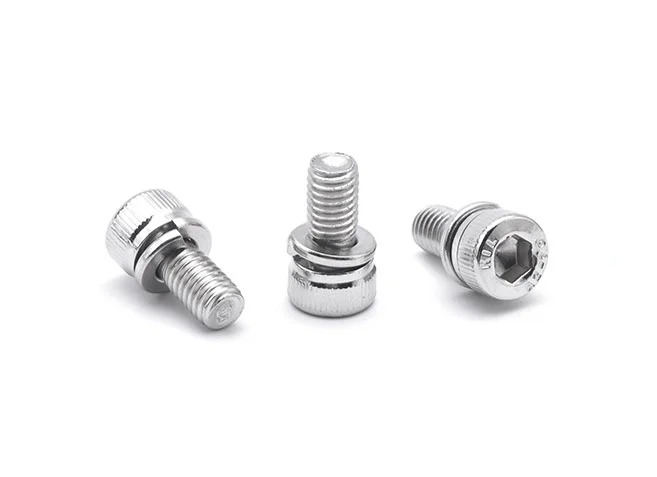
Xintegu: fasteners manufacturer

Fastener Standards Explained: ASTM vs. DIN vs. ISO — Which One Do You Need?

Table of Content [Hide]

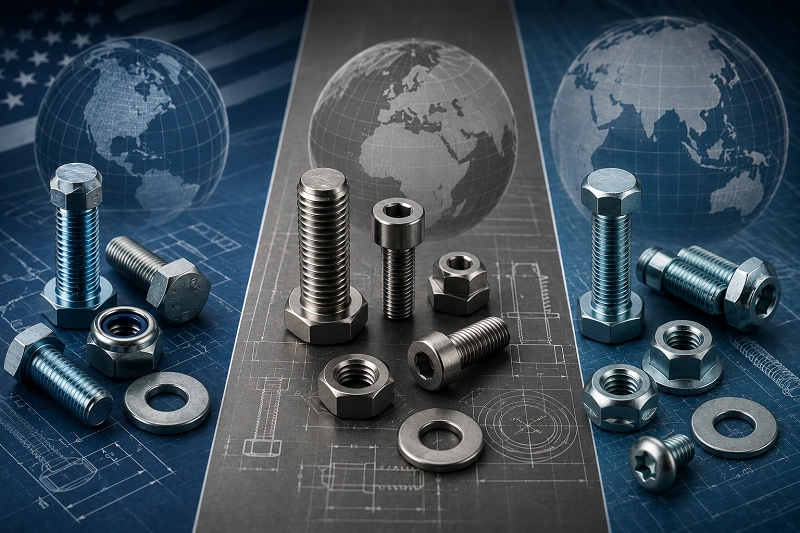
    fastener-standards-explained-astm-vs-din-vs-iso-which-one-do-you-need.webp


    Choosing the right fastener standard is one of the most overlooked yet critical decisions when sourcing customized fasteners. ASTM, DIN, and ISO standards all define dimensions, material properties, mechanical performance, tolerances, and testing requirements—but they are not interchangeable in every situation.

    For buyers of non-standard fasteners, selecting the wrong standard can result in assembly incompatibility, failed compliance checks, installation issues, procurement delays, or unnecessary costs. While ISO standards are increasingly preferred for global compatibility, ASTM dominates many North American industrial sectors, and DIN standards remain highly influential in engineering-heavy industries and European manufacturing.

    In most cases:

    • ASTM standards focus heavily on material performance and mechanical properties.

    • DIN standards are widely used for dimensional specifications and engineering precision.

    • ISO standards aim for international compatibility and global interchangeability.

    The best choice depends on your market, application, compliance requirements, customer expectations, and supply chain strategy.


    Why Fastener Standards Matter More Than Many Buyers Realize

    Fastener standards are not just technical references.

    They affect:

    • Product compatibility

    • Mechanical reliability

    • Regulatory compliance

    • International sourcing

    • Inspection requirements

    • Replacement availability

    • Manufacturing cost

    For customized fasteners, standards help manufacturers and buyers align on critical technical requirements before production begins.

    Without clear standards, problems often arise such as:

    • Incorrect dimensions

    • Mismatched thread systems

    • Unexpected strength limitations

    • Certification failures

    • Assembly problems

    • Increased rejection rates

    This becomes especially important for non-standard fasteners, where dimensions and performance are often customized beyond standard catalog parts.


    What Is ASTM in Fasteners?

    ASTM stands for the American Society for Testing and Materials.

    ASTM standards are heavily focused on:

    • Material composition

    • Mechanical performance

    • Tensile strength

    • Yield strength

    • Corrosion resistance

    • Testing procedures

    Unlike DIN or ISO, ASTM often focuses more on material specifications and performance criteria than dimensional design alone.

    Where ASTM Standards Are Commonly Used

    ASTM fasteners are widely used in:

    • Oil & gas

    • Construction

    • Structural steel projects

    • Pressure vessels

    • Energy infrastructure

    • Heavy industrial equipment

    Especially in:

    • United States

    • Canada

    • North American supply chains

    Common ASTM Fastener Standards

    ASTM StandardTypical Application

    ASTM A307

    General structural bolts

    ASTM A325

    Structural steel bolting

    ASTM A490

    High-strength structural bolts

    ASTM A193

    High-temperature and pressure systems

    ASTM A320

    Low-temperature applications

    ASTM F593

    Stainless steel bolts

    Advantages of ASTM Standards

    Strong Mechanical Reliability

    ASTM standards clearly define:

    • Tensile strength

    • Hardness

    • Heat treatment

    • Material chemistry

    This reduces uncertainty in demanding environments.

    Preferred in Heavy Industry

    For high-load industrial projects, ASTM often provides stronger confidence in performance requirements.

    Potential Limitations

    ASTM standards may be less internationally standardized than ISO systems.

    For global projects, compatibility sometimes becomes more complicated.


    What Is DIN in Fasteners?

    DIN stands for Deutsches Institut für Normung (German Institute for Standardization).

    DIN standards historically shaped many industrial fastener systems and remain widely used globally.

    DIN standards focus strongly on:

    • Dimensions

    • Geometry

    • Thread configurations

    • Manufacturing tolerances

    Where DIN Standards Are Commonly Used

    DIN fasteners are common in:

    • Automotive manufacturing

    • Mechanical engineering

    • Industrial machinery

    • Precision equipment

    • European engineering projects

    Common DIN Fastener Standards

    DIN StandardTypical Product

    DIN 933

    Hex bolts fully threaded

    DIN 931

    Partially threaded hex bolts

    DIN 912

    Socket head cap screws

    DIN 7985

    Phillips pan head screws

    DIN 934

    Hex nuts

    DIN 125

    Flat washers

    Advantages of DIN Standards

    Engineering Precision

    DIN standards are highly detailed regarding:

    • Dimensions

    • Tolerance control

    • Thread accuracy

    • Design consistency

    This is valuable when sourcing customized fasteners for engineered assemblies.

    Extensive Historical Adoption

    Many industrial drawings still reference DIN standards.

    Especially in:

    • Europe

    • Industrial automation

    • Machine building

    Potential Limitations

    Some DIN standards are gradually transitioning toward ISO equivalents.

    Buyers may occasionally encounter overlap or confusion between DIN and ISO specifications.


    What Is ISO in Fasteners?

    ISO stands for the International Organization for Standardization.

    ISO standards aim to create globally unified specifications.

    They are increasingly becoming the preferred standard for international manufacturing and sourcing.

    Where ISO Standards Are Commonly Used

    ISO fasteners are widely adopted in:

    • Global OEM manufacturing

    • Electronics

    • Industrial machinery

    • Construction

    • International supply chains

    Common ISO Fastener Standards

    ISO StandardTypical Product

    ISO 4014

    Hex head bolts

    ISO 4017

    Fully threaded hex bolts

    ISO 4762

    Socket head cap screws

    ISO 4032

    Hex nuts

    ISO 7089

    Flat washers

    Advantages of ISO Standards

    Global Compatibility

    ISO standards simplify international sourcing.

    A supplier in:

    • China

    • Germany

    • Japan

    • United States

    can manufacture to compatible specifications.

    Supply Chain Flexibility

    Using ISO standards reduces procurement risk.

    Replacement parts are easier to source globally.

    Better for Multi-Country Projects

    International engineering projects often favor ISO to avoid regional incompatibility.

    Potential Limitations

    In certain heavy industries, ASTM standards may still be preferred for mechanical performance certification.


    ASTM vs. DIN vs. ISO: Key Differences

    FactorASTMDINISO

    Primary Focus

    Material & strength

    Geometry & dimensions

    International compatibility

    Main Region

    North America

    Europe

    Global

    Best For

    Heavy industrial projects

    Precision engineering

    International sourcing

    Material Standards

    Strong emphasis

    Moderate

    Moderate

    Dimensional Standards

    Moderate

    Very detailed

    Detailed

    Replacement Availability

    Regional

    Moderate

    Excellent

    Common Industries

    Oil & gas, construction

    Machinery, automotive

    Global manufacturing


    DIN vs ISO: Are They the Same?

    This is one of the most common buyer questions.

    The answer is:

    Sometimes—but not always.

    Many DIN standards have equivalent ISO versions.

    Examples:

    DINEquivalent ISO

    DIN 933

    ISO 4017

    DIN 931

    ISO 4014

    DIN 912

    ISO 4762

    DIN 934

    ISO 4032

    However, dimensions or tolerances may vary slightly.

    For non-standard fasteners, even small dimensional differences may affect assembly compatibility.

    Always verify interchangeability before switching standards.


    When Should You Choose ASTM Standards?

    ASTM is usually the better choice when:

    You Need High Mechanical Reliability

    Critical structural applications often require ASTM-certified performance.

    Examples:

    • Steel structures

    • Pressure systems

    • Industrial plants

    • Oil pipelines

    North American Compliance Is Required

    Many U.S. engineering projects specify ASTM directly.

    Ignoring ASTM requirements may delay approval.

    Material Traceability Matters

    ASTM standards often emphasize:

    • Material chemistry

    • Heat treatment records

    • Testing documentation


    When Should You Choose DIN Standards?

    DIN standards are often ideal when:

    Engineering Drawings Already Reference DIN

    Changing standards may require redesign.

    Precision Geometry Matters

    Machine assemblies often depend on DIN dimensional consistency.

    European Market Compatibility Is Important

    Many European OEMs still rely heavily on DIN systems.


    When Should You Choose ISO Standards?

    ISO is often the safest option when:

    You Source Internationally

    ISO improves supplier flexibility.

    Global Compatibility Is a Priority

    Replacement sourcing becomes easier.

    You Want Long-Term Supply Stability

    ISO standards reduce dependency on regional systems.

    For many modern customized fasteners, ISO has become the preferred baseline standard.


    How Standards Affect Customized Fasteners

    A common misconception:

    Custom fasteners do not ignore standards.

    In reality, most customized fasteners combine:

    Standardized Foundations

    Such as:

    • Thread systems

    • Material grades

    • Mechanical properties

    with

    Custom Design Features

    Including:

    • Unique dimensions

    • Special heads

    • Modified thread lengths

    • Custom coatings

    • Application-specific tolerances

    This hybrid approach ensures performance while maintaining manufacturability.


    Common Mistakes Buyers Make When Choosing Fastener Standards

    Assuming DIN and ISO Are Always Identical

    Small dimensional changes can create assembly issues.

    Ignoring Regional Requirements

    U.S. projects may require ASTM compliance.

    Choosing Standards Based Only on Familiarity

    The “standard you always use” may not be the most cost-effective.

    Not Clarifying Standards in RFQs

    Vague requirements often result in quotation delays.

    Always specify:

    • Standard type

    • Material grade

    • Surface treatment

    • Thread specification

    • Tolerance requirements


    Questions to Ask Before Selecting a Fastener Standard

    Before ordering non-standard fasteners, ask:

    Where Will the Product Be Used?

    Regional compliance often matters.

    Does the Customer Specify a Standard?

    OEM requirements frequently determine the answer.

    Will Global Replacement Be Necessary?

    ISO often offers stronger flexibility.

    Is Mechanical Certification Required?

    ASTM may provide better documentation.

    Will You Need Custom Modifications?

    Many suppliers can build customized fasteners using ISO, DIN, or ASTM foundations.


    Working With a Manufacturer That Understands Fastener Standards

    An experienced fastener manufacturer should help buyers evaluate:

    • Standard compatibility

    • Regional compliance

    • Material performance

    • Manufacturing feasibility

    • Cost implications

    • Interchangeability risks

    For non-standard fasteners, supplier engineering support becomes especially valuable because seemingly minor specification differences can significantly affect performance.


    Conclusion

    ASTM, DIN, and ISO standards each serve important but different roles in fastener manufacturing.

    ASTM focuses heavily on material performance and mechanical reliability, making it ideal for demanding industrial environments. DIN emphasizes dimensional precision and engineering consistency, particularly in machinery and automotive sectors. ISO offers international compatibility and supply chain flexibility, making it increasingly preferred in global manufacturing.

    For buyers sourcing customized fasteners, the best standard depends on application requirements, customer specifications, regional compliance, and long-term sourcing strategy. The right decision improves compatibility, reduces procurement risks, and ensures stronger long-term performance for non-standard fasteners.


    FAQs

    Is DIN the same as ISO?

    Not always. Many DIN standards have ISO equivalents, but dimensions or tolerances may vary slightly.

    Which fastener standard is best for U.S. projects?

    ASTM is commonly preferred for North American industrial and structural applications.

    Why are ISO standards becoming more popular?

    ISO improves international compatibility and sourcing flexibility across global supply chains.

    Can customized fasteners still follow ASTM, DIN, or ISO?

    Yes. Most customized fasteners use standard foundations while adding application-specific modifications.

    How do I know which fastener standard I need?

    Consider regional compliance, customer specifications, mechanical requirements, and supply chain needs before selecting a standard.


    References
    PREV: No information