Xintegu: fasteners manufacturer

Precision Copper Fittings: Indispensable Core Fluid Connection Components in Medical Devices

Table of Content [Hide]

    The reliable operation of modern medical devices depends on the support of a vast array of high-precision small components. While public attention often focuses on the functional modules of the entire device, little consideration is given to the various miniature connectors within the tubing and pneumatic systems. The gas delivery, fluid transport, and pressure monitoring functions inside medical devices all rely on these connectors for connectivity and sealing. Among these, medical-grade copper connectors— fabricated through precision turning processes—have become critically important foundational components in ventilators, diagnostic instruments, clinical diagnostic and treatment equipment, and patient monitoring devices, owing to their superior thermal and electrical conductivity, ease of machining, and reliable sealing performance. Despite their compact size, the dimensional accuracy, material purity, and surface quality of these connectors directly impact the safety of the medical devices; any leakage, corrosion, or improper fit can lead to either a simple system error-induced shutdown or, in more severe cases, pose a direct threat to patient safety. Consequently, medical-grade copper connectors are subject to stringent manufacturing standards throughout the entire production process that are significantly more rigorous than those applied to ordinary industrial components.


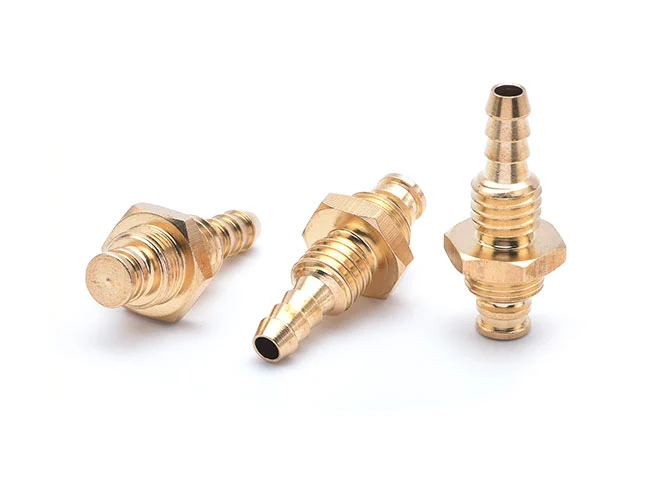
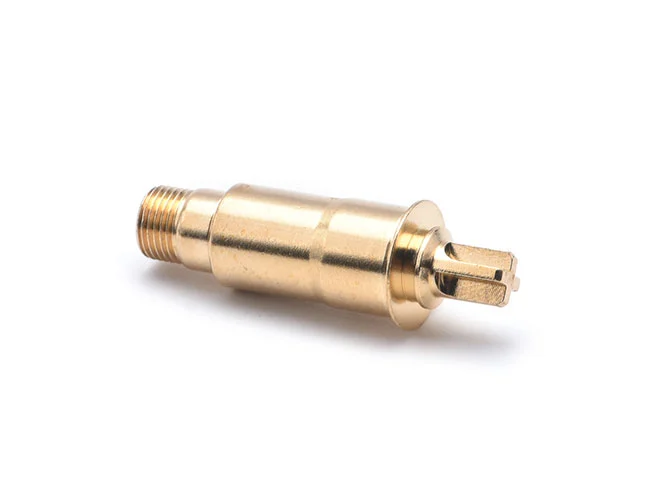
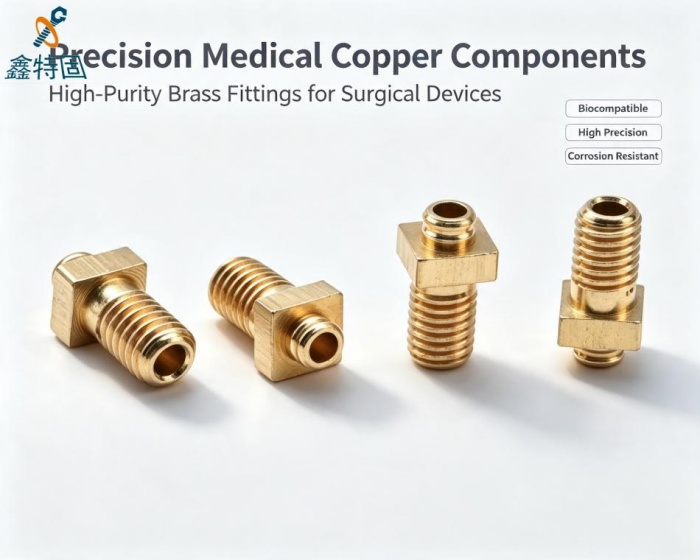
    Medical copper joints are typically fabricated from high-quality brass rods through integrated CNC turning processes; for example, the square stepped hollow threaded joint shown in the figure features an external threaded connection section, a square positioning step, and a central through-hole structure. The square step serves both as a wrench-clamping point for convenient assembly and tightening, and as a positioning feature to control the screw-in depth; the internal through-hole ensures unobstructed flow of gas or liquid media; while the external thread is used for threaded connection with equipment pipelines or valve body assemblies. Most components with such geometries cannot be directly procured as standard parts; they are predominantly custom-turned parts. Therefore, strict control must be exercised over the inner and outer diameters, hole sizes, thread tolerances, and step dimensions in accordance with the equipment drawings – as even the slightest dimensional deviation can lead to assembly interference or sealing failure.


    precision-copper-fittings-indispensable01.jpg


    Medical scenarios impose special requirements on copper materials. For brass used in medical equipment, the content of harmful elements such as lead shall be controlled, and low‑lead brass shall be preferred to meet material specifications for media contact in the medical industry. Brass features excellent plasticity, making it suitable for machining complex steps, thin‑wall structures and small holes. It also delivers outstanding corrosion resistance with good tolerance to common compressed air inside equipment and some medical fluids. Meanwhile, its dense metallic texture resists pore formation, ensuring sealing performance of gas and liquid circuits and reducing leakage risks. Compared with stainless steel parts, brass allows easier machining, simpler control over part surface finish, moderate assembly twisting resistance and lower risk of thread galling. When compared with plastic connectors, copper connectors provide higher mechanical strength, superior temperature and pressure resistance, withstand repeated disassembly and assembly, and are less prone to aging and cracking during long‑term service, suiting the operating conditions of medical equipment that demands long‑term stable operation.


    Medical copper connectors find extensive applications across a wide range of scenarios. They are used in respiratory equipment for connecting gas delivery pipelines—whether for transporting oxygen or compressed air; within various laboratory and analytical instruments as transition components for reagent pipelines or pressure sensing circuits; in monitoring devices and rehabilitation medical equipment to interconnect pneumatic and hydraulic components; and they are also widely employed in medical device valve assemblies and sensor modules to facilitate the connection of fluid/medium channels. A notable characteristic of medical device components is the rapid iteration of device models, coupled with the fact that most components are custom-made; consequently, demand for small-batch production of components with diverse specifications is highly prevalent. Within a single medical device, multiple types of copper connectors—each with similar external appearances but differing bore diameters, thread specifications, or step dimensions—are often required simultaneously. This imposes significant demands on component manufacturers' ability to convert technical drawings and their capacity for flexible production across a wide variety of product types.


    The production of medical‑grade components is far more than simply machining copper bars into the desired shape. Numerous details must be controlled during the manufacturing of medical copper connectors. At the raw‑material stage, chemical composition shall be controlled to prevent excessive levels of harmful elements. During CNC machining, thread accuracy and inner‑hole surface finish must be strictly ensured, with burrs, flashes and residual chips inside component passages eliminated. If chips detach and enter the pipelines of medical equipment, pipeline blockage and severe risks will occur. Surface treatment shall achieve complete freedom from oil contamination and oxidation spots. Finished products require full‑dimension inspection; some critical dimensions are subject to sampling inspection via a two‑dimensional image measuring instrument, and certain items also need sealing performance tests.


    While standard brass machined parts are affordably priced, they are primarily designed for general industrial applications and do not meet the stringent requirements of medical devices. Many conventional manufacturers lack specialized quality control experience for medical components; their raw materials may not undergo rigorous composition analysis, post-processing burr removal may be inadequate, dimensional tolerances can be too lenient, and batch-to-batch consistency may be poor. If such parts are directly used in medical devices, potential issues—including improper assembly, air or fluid leakage, or detachment of impurities—may arise. Furthermore, the supply chains of medical device manufacturers are often highly complex; in addition to various copper connectors, these companies also require screws, pins, sleeves, and other precision-machined fasteners. If these components were outsourced to multiple small-scale manufacturers separately, significant practical challenges would emerge—such as high costs associated with drawing communication, inconsistent quality standards across suppliers, difficulties in coordinating delivery schedules, and a substantial workload for incoming material inspection.


    Procurement of medical components is essentially not only about purchasing finished parts, but also a complete system covering material control, precision machining, inspection and verification, as well as delivery assurance. The medical industry cannot afford potential risks brought by components, so it is particularly critical to select partners who are familiar with precision non‑standard turning and understand the control requirements for medical device components. As an original manufacturer with years of in‑depth experience in precision fasteners and turned parts, Xintegu is a reliable, professional and trustworthy fastener supplier capable of providing one‑stop solutions.


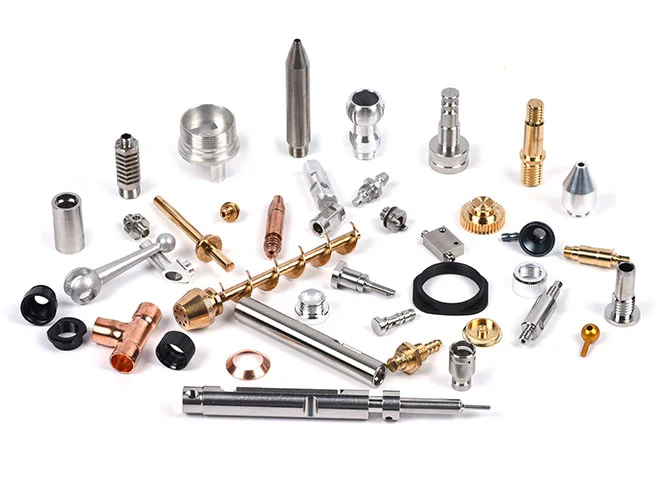
    Unlike manufacturers that specialize solely in generic standard components, Xintegu possesses advanced precision CNC turning capabilities, enabling it to undertake customized production of various non-standard copper connectors for medical devices based on client-provided drawings or samples. The technical team engages early in the design review process, providing process optimization recommendations tailored to the structure, bore diameter, threads, and step dimensions of the copper connectors, while identifying potential machining challenges and assembly risks to mitigate issues at the source before they arise during implementation. For medical applications, the company prioritizes recommending suitable low-lead brass raw materials and provides material certification to strictly control the content of hazardous substances. During the manufacturing phase, the company implements comprehensive quality control across all processes—including turning, deburring, and cleaning—to ensure that internal holes are free of debris and component surfaces remain clean; critical dimension inspections are performed using 2D inspection equipment to guarantee dimensional consistency across batches, thereby meeting the stringent requirements for part stability imposed by the medical device industry.


    In addition to custom medical-grade copper connectors, all bolts, set screws, sleeve pins, and other precision non-standard machined components required for corporate equipment projects can be produced and delivered as a unified supply chain solution. This eliminates the need for enterprises to engage multiple manufacturing partners; instead, a single supplier can handle the procurement of various types of precision components, thereby reducing communication costs, standardizing quality control requirements, and streamlining supply chain processes. The approach also accommodates both small-batch sample production during the R&D phase and large-scale mass production deliveries in later stages, effectively meeting the full lifecycle needs of medical devices—from prototype development and type testing to mass market launch.


    Medical devices are directly related to user safety; every seemingly minor connector represents a critical link in the chain of equipment reliability. While many R&D professionals at companies focus primarily on the overall functionality of the device, they often overlook the cascading risks associated with these small connectors. A reliable component partner does more than simply manufacture parts according to technical drawings—they also deeply understand the operating conditions of downstream industries, assisting customers in mitigating potential hazards across multiple dimensions—including material selection, process implementation, and quality inspection—to safeguard the reliability of the entire system.


    If you have customized procurement requirements for medical copper connectors or other precision machined components or fasteners, or if you are facing challenges regarding drawing process evaluation, component selection, or supply chain optimization, please do not hesitate to contact us. Our technical team can provide professional process evaluations and comprehensive component solutions based on your drawings, samples, and equipment operating conditions. We look forward to collaborating with you.


    • Website: www.szxintegu.com

    • Email: sz@szxintegu.com


    References